


MCD cutting tools: monocrystalline diamond for mirror-finish machining
Single-crystal diamond edges, ground to a sub-micron radius, turn aluminium, copper, optical plastics, infrared crystals and graphite into reflective surfaces without a polishing step. This guide sets out what MCD tooling is, where it beats PCD, what to specify, and where it fails.
1. What “MCD” actually means
Three acronyms get confused constantly: MCD, PCD and CVD. They are different materials, not marketing tiers.
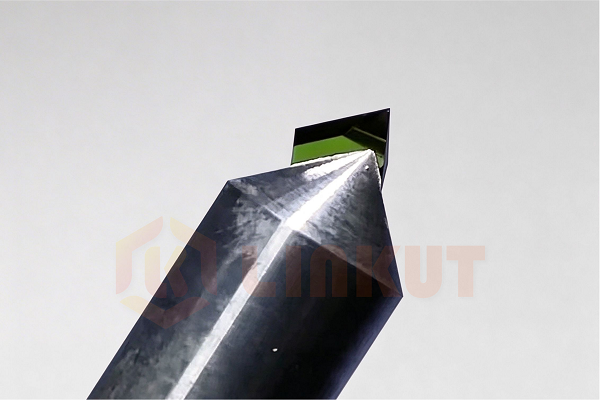
MCD stands for monocrystalline diamond. The cutting edge is one crystal, either grown by chemical vapour deposition as a single-crystal block or produced under high pressure and high temperature. Because the entire edge shares one crystallographic orientation, it behaves like a single continuous piece of diamond rather than a mosaic.
That single orientation is the whole point. In a polycrystalline material the edge is a chain of randomly oriented grains, and the boundaries between them are mechanically weak and chemically less stable. Those boundaries are where a PCD edge starts to micro-chip, and where the workpiece sees an inconsistent cutting edge. A monocrystalline edge has no such interruptions: rake face, clearance face and edge radius can be lapped smooth in one continuous surface.
The practical result is a cutting edge that separates material rather than abrading it, which is why MCD machining of aluminium and copper produces a specular surface straight off the tool, and why MCD is the default choice for diamond turning of infrared optics.
The three diamond options in one sentence each
· MCD (monocrystalline diamond): sharpest possible edge, best surface finish, small and relatively brittle, highest cost per tool.
· PCD (polycrystalline diamond): many grains sintered with a metallic binder, tougher and cheaper, available in large diameters, but the edge cannot be as sharp.
· CVD diamond (coating): a diamond layer grown onto a carbide substrate, which extends carbide life but keeps carbide edge quality.
2. MCD vs PCD vs CVD diamond
Use the comparison below to decide which edge material belongs on the job, not which one is “better”.
Table 1 Comparison of diamond edge materials for cutting tools
Property | MCD | PCD | CVD diamond coating |
Structure | Single crystal, one orientation | Many randomly oriented grains with binder | Diamond film on carbide substrate |
Edge radius | Sub-micron, lapped continuous edge | Limited by grain size | Limited by substrate edge |
Surface finish | Nanometre-level Ra possible | Fine, but not mirror grade | Fine, below PCD on same edge prep |
Chip resistance | Low — brittle crystal | High — grain network arrests cracks | Moderate; coating can spall |
Practical diameter range | Small tools, micro to about 6 mm | Wide, large inserts common | Follows carbide tool range |
Relative cost | Highest per cutting edge | Moderate | Lowest |
Best fit | Optical finish, IR optics, light guides | Volume aluminium, composites, roughing to finishing | Cost-sensitive non-ferrous production |
The short version: choose PCD when you need toughness and size at a workable price, choose CVD when you want to extend an existing carbide tool, and choose MCD when the specification is the surface finish itself, such as an optical face, a light guide, an infrared window or a bright-cut jewellery face.
3. Where MCD cutting tools win
Five application families where a monocrystalline edge pays for itself.
3.1 Infrared and precision optics
Germanium, zinc sulphide, zinc selenide, silicon and chalcogenide glass are machined by single-point diamond turning to a reflective finish that needs no polishing step. This is the oldest and least substitutable MCD application: the surface tolerance and the absence of scatter are set by the edge quality.
3.2 Optical plastics and light guides
PMMA light guide plates, polycarbonate lenses, CR-39 ophthalmic blanks and acrylic displays are cut with MCD ball-nose and flat end mills. Sharp monocrystalline edges reduce pull-out and burnishing on soft polymer, which is what causes haze and edge whitening around a milled feature.
3.3 Mirror finishing of non-ferrous metals
Aluminium, copper, brass, gold and silver can be faced and milled to a specular surface. In practice this covers reflector cavities, optical moulds, watch and jewellery bright cutting, and high-end cosmetic and decorative parts. On 6061-type aluminium the finish is limited by the tool edge and machine rigidity, not by the material.
3.4 Graphite and carbon materials
Graphite electrodes, carbon composites and carbon-fibre laminates are abrasive and destroy carbide edges quickly. MCD and PCD both survive here; MCD is used where the graphite component also needs a fine surface and a controlled edge, such as EDM electrode details and small moulds.
3.5 Semiconductor and mould tooling
Encapsulation moulds, optical mould inserts, wafer-related tooling and precision platens benefit from an edge that leaves no smear and no micro-scratch on the parting face, which is the defect class that later shows up as a cosmetic reject on a moulded part.
Form factors
MCD is available as flat end mills, ball-nose cutters, engraving and router bits, micro drills, grooving and profiling tools, and turning inserts. A monocrystalline blank is small, so tool design has to respect crystal size. This is a geometry constraint, not a supplier limitation.
4. Where MCD fails
Buying an MCD tool for the wrong material is the most expensive mistake in diamond tooling. The five failures below are the ones that matter commercially.
4.1 Steel, iron, titanium and nickel alloys
Diamond reacts with iron-group metals at cutting temperature; the edge graphitises and wears at a rate that makes the tool uneconomic within minutes. Use CBN or carbide for these materials.
4.2 Heavy interrupted cuts and cast surfaces
A single crystal has no grain network to stop a propagating crack. Scale, sand inclusions and interrupted edges cause fracture rather than gradual wear.
4.3 Roughing with large depth of cut
MCD is a finishing and semi-finishing technology. Stock removal belongs to carbide or PCD.
4.4 Large diameters on a tight budget
Crystal size limits the blank, and cost rises sharply with edge length.
4.5 Machines with poor rigidity or high runout
A monocrystalline edge is unforgiving. Runout and vibration show up directly in the surface, so the stable window is usually narrower than with carbide.
5. What to send us for an accurate MCD quotation
A drawing plus seven data points is enough to quote and to design the edge correctly.
1. Tool type and geometry: end mill, ball nose, router, drill or insert; diameter, corner radius, nose radius, flute count, overall length, shank or thread interface.
2. Workpiece material and condition: exact grade (for example 6061-T6, C1100, PMMA, Ge, ZnSe or fine-grain graphite), plus whether the surface is as-cast, pre-machined or a finished face.
3. Required surface finish and tolerance: target Ra, flatness or profile tolerance, and whether polishing is allowed afterwards. This decides whether MCD is necessary at all.
4. Machine and spindle: spindle speed range, taper or holder type, runout measured at the tool, and coolant availability (dry, MQL or flood).
5. Operation sequence: depth of cut, feed per tooth, whether the tool also has to clear a shoulder or a wall, and the expected tool life in parts or metres.
6. Edge preparation preference: whether a small honed edge radius is acceptable for robustness, or a sharp edge is required for finish.
7. Quantity and delivery: prototype, pilot batch or recurring supply, and the date the tool has to be in the machine.
6. Cutting parameters
The figures below are indicative starting points for MCD milling. Every machine and fixture changes the window, so validate before production.
Table 2 Indicative starting parameters for MCD milling, to be validated on the actual machine
Work material | Spindle speed | Feed per tooth | Cooling |
Aluminium, brass, copper | High speed, 20,000–60,000 rpm on small tools | 0.005–0.05 mm | Dry or MQL; flood acceptable |
Optical plastics | 20,000–40,000 rpm | 0.01–0.05 mm | Air or MQL; avoid coolant staining |
Germanium, ZnSe, ZnS | Single-point or fly-cutting geometry | Micrometre-level depth per pass | Dry, temperature-controlled |
Graphite | High speed with dust extraction | 0.01–0.03 mm | Dry, extraction mandatory |
Two rules override any table. First, runout at the cutting edge should be held as tight as the machine allows, a fraction of the feed per tooth rather than a fraction of the diameter. Second, depth of cut should stay modest; an MCD tool is there to create the final surface, not to remove stock.
7. What a credible MCD tool should come with
The difference between a good and a bad monocrystalline tool is invisible until it is in the spindle. The following items should be part of the delivery.
· Crystal grade and orientation stated on the certificate, not just “diamond”.
· Edge radius measurement reported per tool, not as a catalogue figure.
· Runout (TIR) recorded at the cutting edge, on the shank the customer will actually use.
· Photographic edge report at magnification, so micro-chipping is visible before shipment.
· Traceable lapping process: a monocrystalline edge is made by a grinding and lapping sequence, and re-lapping after service should restore the same edge geometry.
· Application note stating the parameters the tool was designed for.
Tools can be re-lapped and returned to service, which is one reason the per-part cost of an MCD tool is usually lower than its purchase price suggests.
8. Frequently asked questions
What does MCD stand for in cutting tools?
MCD stands for monocrystalline diamond. It describes a tool whose cutting edge is a single continuous diamond crystal, as opposed to PCD, which is polycrystalline diamond made of many grains sintered together.
Is MCD better than PCD?
Neither is universally better. MCD gives a sharper edge and a finer surface finish, and is the right choice when the surface itself is the specification. PCD is tougher, available in larger sizes and far cheaper per edge, and is the right choice for volume production, interrupted cuts and stock removal. Many shops use PCD to rough and MCD to finish.
Can MCD cut steel or stainless steel?
No. Diamond reacts chemically with iron-group metals at cutting temperature, so the edge graphitises and wears very rapidly. For hardened steel use CBN, and for general steel use carbide. This is a material limitation, not a quality issue with a particular supplier.
What surface finish can MCD achieve?
On suitable non-ferrous materials, a monocrystalline edge can produce nanometre-level Ra and an optical, mirror-grade surface directly from the cut, with no subsequent polishing. The achievable figure depends on the edge radius, machine rigidity, runout and fixturing as much as on the tool.
What spindle speed should I run an MCD tool at?
Small MCD milling tools typically run in the 20,000–60,000 rpm range with a light feed per tooth, while single-point diamond turning uses much lower spindle speeds with micrometre-level depth of cut. Treat these as starting points and validate on the machine: an MCD edge is sensitive to runout and vibration, so the stable window is often narrower than with carbide.
Can MCD tools be resharpened?
They can be re-lapped, and a worn monocrystalline tool is usually returned to the same edge geometry rather than discarded. Ask for the lapping and inspection record with the original tool so the re-lapped version can be verified against it.
How is a custom MCD tool quoted?
Price depends on crystal size and grade, tool geometry, edge preparation, coating or no coating, inspection level and quantity. Send a drawing with the workpiece material, required finish, machine and runout so the quote reflects the edge that actually has to be produced; a price without those inputs is a guess.
Does LINKUT supply MCD tools alongside PCD and CBN?
Yes. LINKUT manufactures custom PCD, CBN, MCD and sintered diamond cutting tools, including micro tools from 0.3 mm, profile and router cutters, thread and multi-edge micro mills, and inserts. Prototype and pilot quantities are accepted so the edge can be proven on your machine before series supply.
Send the drawing, get a real answer
Send your drawing, workpiece material and target surface finish. You will receive a tool proposal with edge geometry, recommended parameters, inspection plan and a price that reflects the actual specification, including an honest answer if MCD is the wrong material for your job.
Previous Article:none
Next Article: Process Innovation | MCD Diamond Burnishing Tool
- LINKUT PCD Spectacle Lens Turning Tool FO1097 DX FO1091DX | RV Optical Lens Cutter Matches Satisloh Coburn
- What part of Cylinder Liner is PCBN Tool suitable for machining?
- What is the use of PCD Tools with a chipbreaker?
- Characteristics and Application of CVD Diamond Tools
LINKUT Precision Tools CO.,Ltd
No. 70 Dianchang Road, High-tech Industrial Development Zone, Zhengzhou. China.


