


Market Analysis of Micro PCD Drill Industry
Micro PCD drills are manufactured with polycrystalline diamond materials, featuring high hardness, superior wear resistance, and excellent thermal stability. As essential consumables for precision manufacturing and high-end equipment industries, they are specially applied in ultra-fine machining of super-hard materials and high-precision micro holes. Widely used in micro-hole processing for semiconductors, high-end electronic components, ceramics and composite materials, micro PCD drills outperform traditional cemented carbide micro-drills in tool service life, cutting stability and hole wall quality, effectively reducing processing losses and overall costs in high-end manufacturing.
According to statistics from QYResearch, the global market sales of micro PCD drills reached USD 75 million in 2025, with a shipment volume of 228,200 pieces and an overall industry gross profit margin of 30.64%, reflecting a significant premium for high-end products. The Chinese market serves as the core growth driver worldwide, recording a market size of USD 28.5 million in 2025, accounting for 38% of the global share. It is projected to grow to USD 46.2 million by 2032, with the global proportion rising to 42%. From 2026 to 2032, the global market will maintain a compound annual growth rate (CAGR) of 5.6%, exceeding USD 110 million in sales by 2032 and achieving sustained and steady industry expansion.
The global market consists of four core regions: North America, Europe, Japan and China, with distinct differentiated development characteristics. Benefiting from mature semiconductor and aerospace industries, North America maintains stable demand for high-end micro PCD drills, holding a 27% global market share in 2025. Europe focuses on aerospace composite material processing, with strong demand for high-aspect-ratio micro PCD drills, accounting for 22% of the global market. As a traditional powerhouse in precision tool manufacturing, Japan boasts leading technologies and renowned manufacturers, occupying a 13% market share. Supported by clustered PCB and semiconductor industries, China leads the world in demand growth, with a projected CAGR of 7.2% from 2026 to 2032, higher than the global average.
The global micro PCD drill industry features high market concentration, with the high-end segment long dominated by international leaders including Asahi Diamond and Sandvik Coromant. Domestic substitution in China is accelerating, with local leading enterprises such as DingTai High-Tech, Jinzhou Precision and Beijing Worlde rapidly expanding market influence. Notably, DingTai High-Tech captured a 28.9% share in the global PCB micro-drill market in 2025. Meanwhile, LINKUT, a rising manufacturer with over ten years of expertise in super-hard cutting tools, has emerged rapidly in the micro PCD drill sector. Leveraging self-developed patented technologies, stable mass production capacity and customized professional services, LINKUT has continuously penetrated global high-end markets.
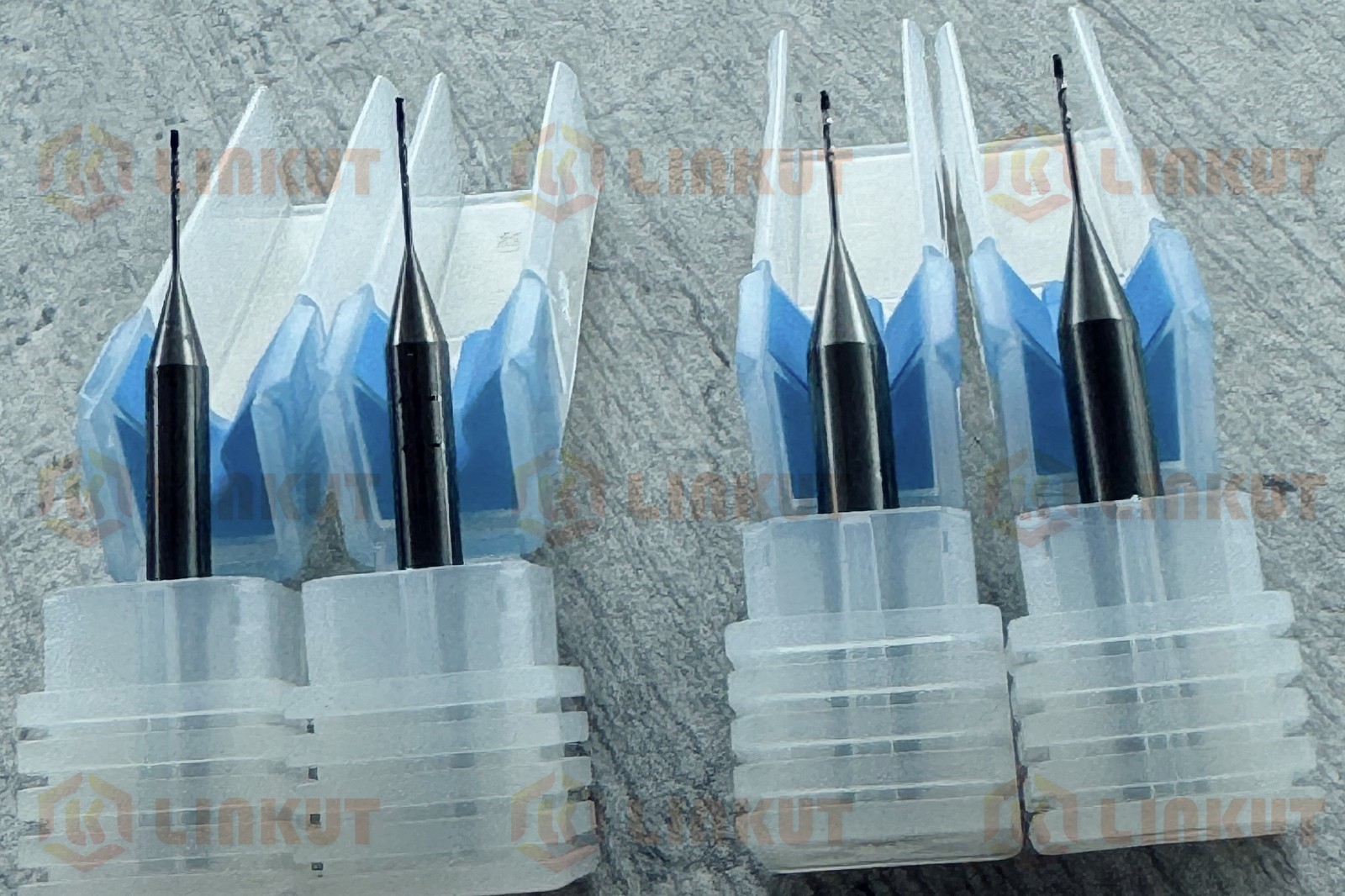
LINKUT micro PCD drills adopt a composite structure with a polycrystalline diamond cutter head and a cemented carbide shank, combining exceptional wear resistance and structural toughness to effectively solve breakage problems in micro-hole machining. Their service life is 50 to 100 times longer than traditional tungsten steel drills. Equipped with a self-centering precision structure and optimized chip removal grooves, the products enable high-aspect-ratio precision drilling with no edge chipping or burrs, delivering outstanding hole wall accuracy and production yield. They are widely applicable to semiconductor micro-holes, high-end PCBs, aerospace composite materials and other precision processing scenarios, while supporting non-standard customization and full-process technical empowerment. In terms of market segmentation, the 0.1-0.3mm specification dominates the market with a 45% share due to strong demand for semiconductor micro-hole processing. Standard shank and TiN/TiAlN coated products are mainstream choices, while diamond-like carbon coated products register the fastest growth, driving continuous optimization of the industry segmentation structure.
Upstream industrial upgrading, technological iteration and global market expansion have brought abundant growth opportunities for the industry. The upgrading of AI servers and advanced semiconductor packaging has promoted PCBs to develop toward higher layers and smaller apertures, sharply boosting demand for 0.1-0.3mm ultra-fine micro drills. The rapid development of new energy vehicles and energy storage industries, along with the widespread application of high-density PCBs, further expands the market for high-end micro drills. Additionally, continuous technological breakthroughs in domestic self-developed production equipment and processes reduce manufacturing costs and improve product performance. Accelerated domestic substitution and active exploration of emerging markets in Southeast Asia, Central Asia and South America help enterprises disperse regional trade risks and unlock new growth potential.
The industry also faces prominent constraints and challenges. The R&D and manufacturing of micro PCD drills have extremely high technical barriers, relying heavily on imported core precision equipment and high-end raw materials with a delivery cycle of up to one year, making it difficult for small and medium-sized enterprises to enter the market. Furthermore, fluctuating global supply chains and raw material prices, coupled with additional 25% tariffs imposed on China’s super-hard cutting tools since 2024, have increased export costs by 15%-20% and squeezed corporate profit margins. Meanwhile, continuously upgraded precision and yield standards from downstream customers require sustained high R&D investment, intensifying market competition. In the future, market demand will shift toward nano-level precision, high-wear-resistance and high-aspect-ratio products, and PCD drills will gradually replace traditional tungsten steel drills on a larger scale.
Overall, the global micro PCD drill industry will maintain steady growth from 2025 to 2032 with broad development prospects, and China will remain the core growth pole of the global market. Industry growth is mainly driven by downstream high-end manufacturing upgrading, domestic technological innovation and import substitution. Domestic enterprises need to break through bottlenecks in core equipment and raw materials, upgrade products to the high-end level, and optimize global supply chain layouts to avoid trade risks. Focusing on ultra-fine specifications, new coating technologies and high-growth downstream tracks including semiconductors and new energy vehicles will be the key to differentiated competition. The industry will generally develop toward high-end positioning, localized production and diversified applications.
Previous Article:none
Next Article: Diamond Polishing Tools: Premium Tools for Ultra-Precision Mirror Finishing
- What part of Cylinder Liner is PCBN Tool suitable for machining?
- What is the use of PCD Tools with a chipbreaker?
- Characteristics and Application of CVD Diamond Tools
- Types and Applications of MCD Diamond Tools
LINKUT Precision Tools CO.,Ltd
No. 70 Dianchang Road, High-tech Industrial Development Zone, Zhengzhou. China.


